
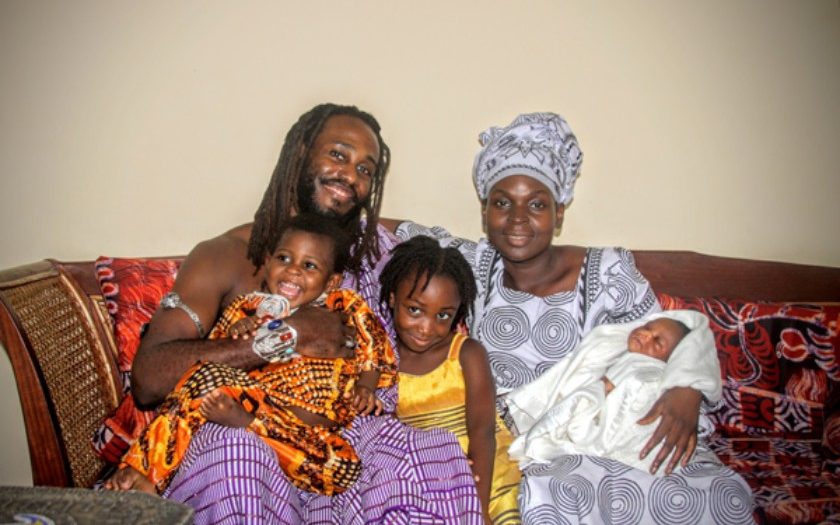
African American Ọbádélé Kambon has never looked back since moving to Ghana in 2008 and becoming a citizen.
He vowed to quit the US for Ghana after being the victim of a racially motivated arrest.
Mr Kambon has now built a successful life in the place that was once at the heart of the slave trade, and enjoys the freedom which, he says, was denied to him in the US, his birthplace.
He says he no longer looks over his shoulder, worrying that police will pull him over or, worse still, kill his son.
Mr Kambon says the turning point in his life came in 2007 when he was arrested and put on trial in Chicago where he lived after being accused by police officers of having a loaded firearm under his car seat and intending to commit a drive-by shooting.
In fact, he had an unloaded licensed gun, used earlier to secure a campsite, in his car boot.
Kambon recalls that he was shocked by the charges and as he sat in the court, he vowed: “Never again will I allow myself to be in a jurisdiction where corrupt white police officers and a judge will take me away from my family, wife and kids just on a whim.”
Mr Kambon who was a young academic teaching at schools and universities in the Chicago area was eventually cleared of the charge.
He then saved up about $30,000 (£24,000) and relocated to Ghana’s capital, Accra, the following year.
He was joined by his wife Kala, and the couple now have three children, Ama, Kwaku and Akosua.
Since moving to Ghana, he has noticed that he no longer feels he is a victim of racial profiling or racial abuse.
Ọbádélé Bakari Kambon, Ph.D. was born in Brooklyn, New York. Upon completing high school, he attended Morehouse College in Atlanta Georgia on a full academic scholarship where he majored in African American Studies.
Kambon started his doctoral studies in linguistics at the University of Ghana in 2009 and now teaches at its Institute of African Studies.
He points out that his friend felt likewise when he relocated, and quipped: “Wow, this is what it must feel like to be a white person in America, just to be able to live without worrying that something is going to happen to you.”
Mr Kambon is fluent in two West African languages Akan and Yoruba and is proficient in a third, Wolof. He also has some level of competency in Swahili, East Africa’s main language, and in Kikongo, spoken in parts of southern and central Africa.
Source:BBC Africa